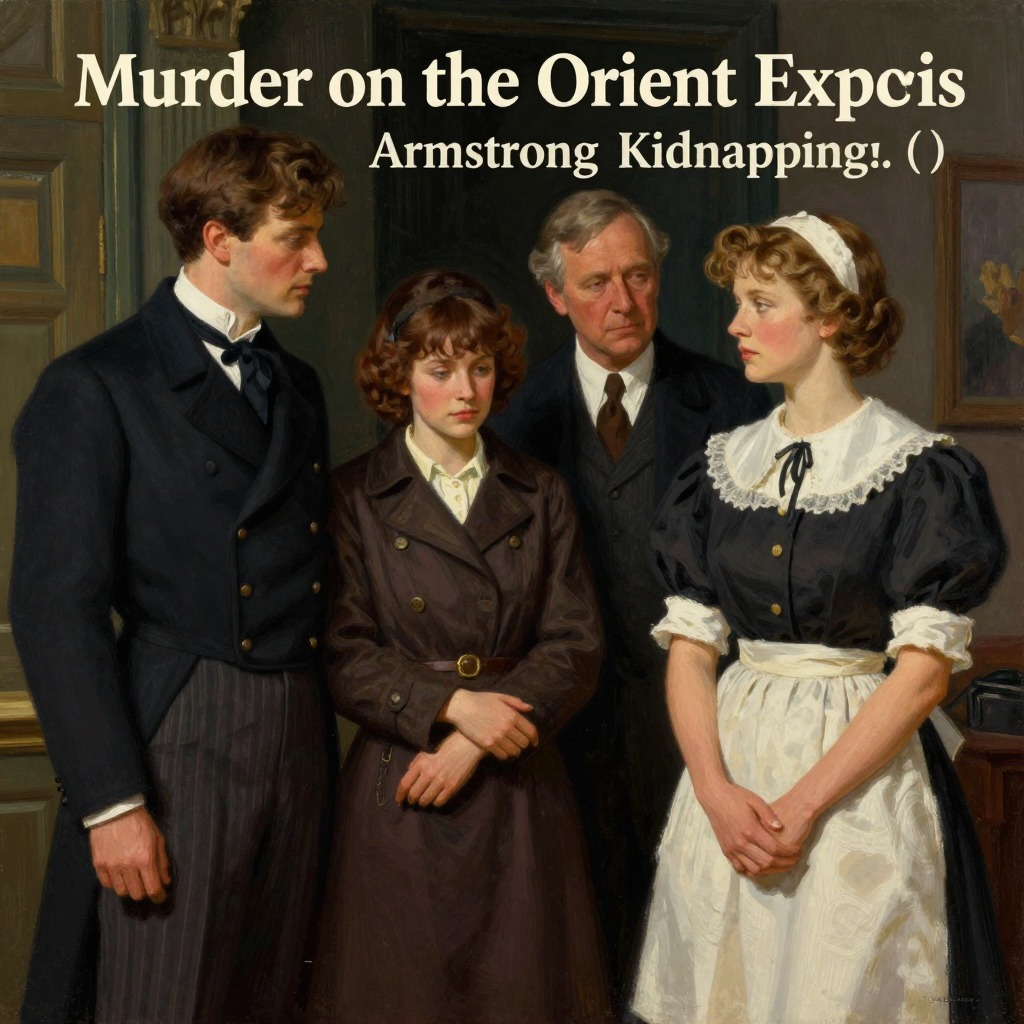
Samuel Edward Ratchett
Samuel Edward Ratchett, the victim at the heart of Murder on the Orient Express, is a wealthy American whose outwardly respectable appearance masks a history of profound criminality. He is the man who, under his real name Cassetti, orchestrated the kidnapping and murder of three-year-old Daisy Armstrong, a crime that led to the destruction of an entire family. His murder on the train, stabbed twelve times in his locked compartment, is not a random act of violence but the culmination of a meticulously planned act of collective vengeance by those whose lives he shattered.
Identity and Background
Ratchett presents himself as a rich, elderly American gentleman travelling with his secretary, Hector MacQueen, and his valet, Edward Masterman. He is described as having a bland, philanthropic appearance—a slightly bald head, a domed forehead, and a smiling mouth with very white false teeth. However, his eyes betray him: they are small, deep-set, and crafty, and Hercule Poirot senses a strange malevolence and an unnatural tensity in his glance. Poirot later describes the impression as being like a wild animal looking out from behind the bars of a respectable cage. In reality, Ratchett is Cassetti, the head of a kidnapping gang who, after the Armstrong case, used his enormous wealth and secret hold over various persons to secure an acquittal on a technicality, then changed his name and fled America to live as a gentleman of leisure abroad.
Life and Plot Trajectory
Ratchett's journey on the Orient Express is his last. He is a man who knows he is in danger, having received threatening letters. He attempts to hire Poirot for protection, offering big money, but Poirot refuses, stating bluntly, "I do not like your face, M. Ratchett." Undeterred, Ratchett hires the American detective Cyrus Hardman to guard him. On the second night of the journey, after the train becomes snowbound in Jugo-Slavia, Ratchett is found dead in his berth, stabbed multiple times. His body is discovered with his pyjama jacket unbuttoned, revealing a dozen stab wounds, some feeble and some delivered with great force. A gold watch in his pyjama pocket is dented and stopped at 1:15, a time later revealed to be a deliberate misdirection.
Key Actions and Objectives
Ratchett's primary objective is self-preservation. He is aware of a specific enemy—described as a small, dark man with a womanish voice—and takes precautions, including hiring Hardman and keeping an automatic pistol under his pillow. However, his plans are thwarted. He is drugged with a sleeping draught, likely administered by his own secretary or valet, rendering him helpless. The evidence shows he was incapable of defending himself, as there were no signs of a struggle. The final, crucial action in his story is the discovery of a charred note in his compartment, which Poirot reconstructs to reveal the words "member little Daisy Armstrong," exposing his true identity and the motive for his murder.
Relationships and Conflict
Ratchett's relationships are transactional and marked by distrust. His secretary, MacQueen, admits to disliking and distrusting him, believing him to be a cruel and dangerous man. His valet, Masterman, is similarly unaffectionate, describing him as a generous employer but not someone he liked. The other passengers, particularly those connected to the Armstrong case, view him with hatred. Mrs. Hubbard, who is later revealed to be Linda Arden, the grandmother of the murdered child, is terrified of him and senses something evil. The central conflict is not between Ratchett and any single individual, but between him and the collective force of the twelve people he has wronged, who have formed a self-appointed jury to execute him.
Change and Ending
Ratchett's story ends with his death. He is the catalyst for the novel's central mystery, but he undergoes no personal change or redemption. His fate is sealed by his past actions. The revelation of his identity as Cassetti transforms the investigation from a simple whodunit into a complex moral puzzle. Poirot ultimately presents two solutions: one involving an outside assassin who escaped, and the other, the true solution, that Ratchett was killed by a jury of twelve passengers, each of whom stabbed him once. The novel concludes with the conspirators, led by Linda Arden, confessing, and Poirot, M. Bouc, and Dr. Constantine agreeing to present the false solution to the authorities.
Narrative Role and Evaluation
Ratchett functions as the ultimate antagonist, a figure of pure evil whose past crimes justify, in the eyes of his killers, the extreme act of private vengeance. He is a flat character in the sense that he is built around a single idea—his guilt and his villainy—but his role is essential to the novel's thematic exploration of justice, morality, and the limits of the law. His murder is not a puzzle to be solved for its own sake, but a moral dilemma that forces Poirot and the reader to confront the question of whether an act of collective, premeditated killing can ever be justified. His death is the event that unites a diverse group of strangers into a single, purposeful entity, making him the unseen center around which the entire plot revolves.